

Every September it starts again. You walk out to grab the mail and take a strand of web across the face. The eaves over the garage are full of silk, there’s a fat orb weaver parked in the corner of the porch light, and somebody inside just found a big brown spider racing across the laundry room floor. So you head to the hardware store and stare at a shelf full of outdoor spider sprays, all of them promising to keep spiders away for good.
Some of those products help. None of them work the way the label photo suggests. Here’s what outdoor spider spray can and can’t do around a Treasure Valley home, where to put it if you use it, and what tends to make the bigger difference.
Which Spiders You’re Actually Dealing With
Before picking a product, it helps to know who’s on the porch. Around Boise, Eagle and Meridian, most of what homeowners see falls into a few groups:
- Orb weavers and cross spiders. The big round webs on eaves, porch lights and shrubs, mostly late summer into fall. Mostly a nuisance, but they can coat the front of a house fast.
- Funnel-web builders, including hobo spiders. Flat, sheet-like webs with a tunnel at the back, tucked into window wells, rock edging, woodpiles and the gap under siding.
- Wolf spiders. Hunters that don’t build webs. They wander in under doors and show up in garages and basements, especially when the weather turns.
- Black widows. Messy, tangled webs low and protected: meter boxes, irrigation valve boxes, under patio furniture, in garage corners.
That mix matters, because a spray that knocks down a web-builder sitting in the open won’t do much for a wolf spider that never sits still or a widow tucked inside a valve box. If you’re not sure what you’ve got, our spider identification guide has photos and notes for the species that turn up in Idaho.
Contact Sprays vs. Residual Sprays
Almost every outdoor spider product on the shelf fits into one of two camps.
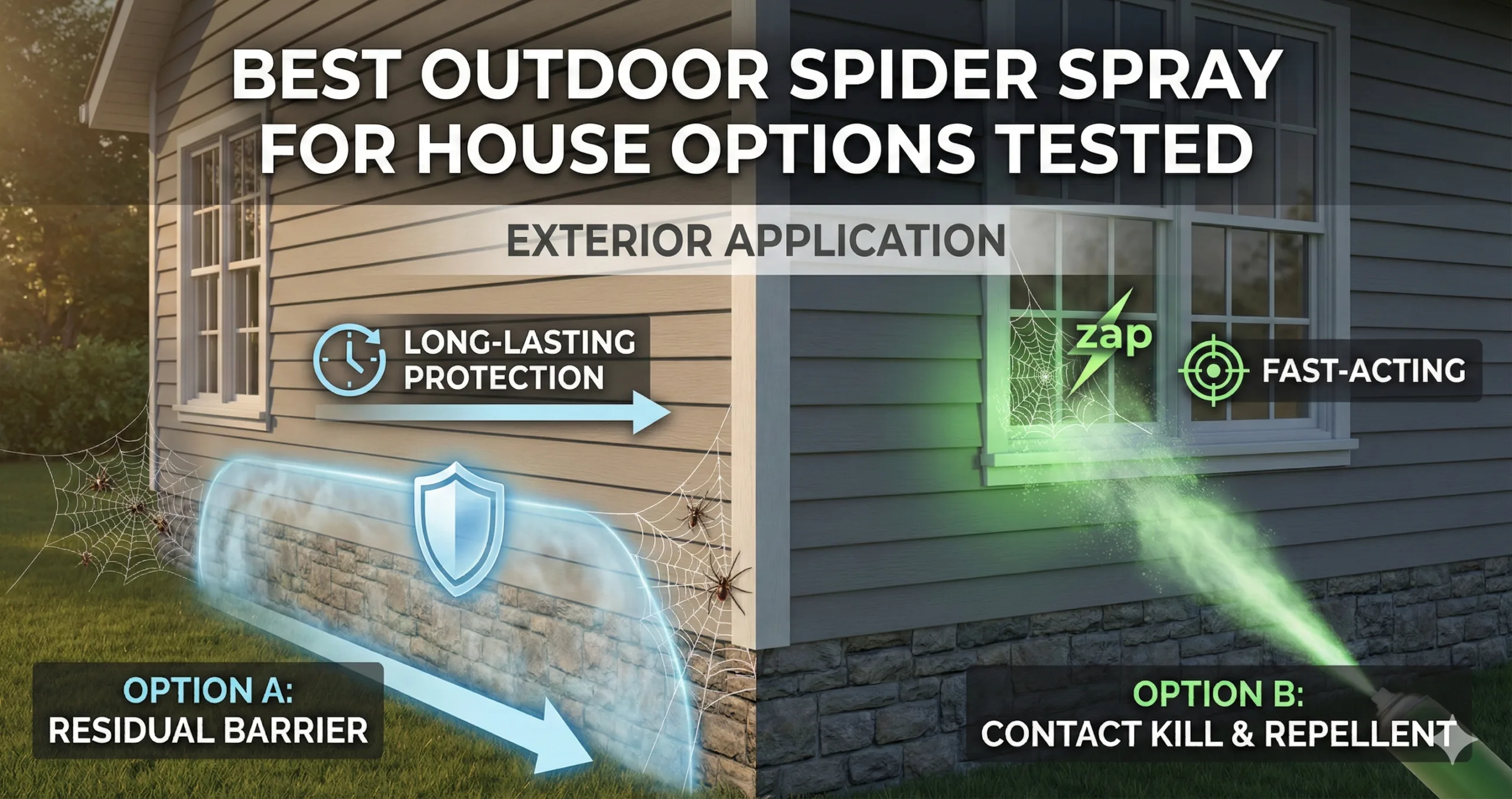
Contact sprays
These kill the spider you hit, more or less on the spot. That’s satisfying, and it’s fine for a single black widow in the garage corner. The catch is that once the spray dries, there’s little or nothing left behind. Spiders that walk across that same spot tomorrow won’t notice it.
Residual sprays
Residual products are designed to leave a thin film on the surface that keeps working for a while after it dries. This is what people usually mean when they talk about “spraying a barrier” around the house. A residual can help, but how long it lasts depends heavily on where it lands. Our summer sun is hard on anything sprayed on south- and west-facing walls, sprinklers wash product off the bottom of the siding, and dust off the foothills settles on everything. A treatment that looks great in the first week can be thin by the end of the month on an exposed wall.
Whichever you pick, the label is the instruction manual. It tells you where the product can go, how much to use and how long to keep people and pets off treated areas. The EPA has a plain-language overview of how to read a pesticide label that’s worth a few minutes before you mix anything.
Where Spray Goes Makes More Difference Than Which Spray
When we look at homes where the owner has been spraying all summer with little to show for it, the product is rarely the problem. Placement is. A few spots matter most:
- The foundation line. A band along the base of the house where the siding meets the concrete, where wandering spiders actually travel.
- Doors, windows and garage door edges. The weather stripping corners and the track of the big garage door are where spiders, and the insects they eat, get inside.
- Eaves and soffits. Brushing webs down first, then treating, works far better than spraying through a thick web.
- Window wells, rock edging and utility boxes. The protected, shady spots where funnel-web spiders and widows set up.
Spraying the whole lawn or blasting the middle of a wall mostly wastes product. The edges and cracks are where the action is.
What Works Better Than Any Spray Alone
Spiders go where the food is. A porch light that pulls in insects every night is basically a buffet sign, and the orb weavers know it. Spray helps, but these changes make it work a lot better:
- Switch exterior bulbs to yellow or warm LEDs, or put porch lights on a motion sensor, so fewer insects gather by the door.
- Pull mulch, rock and dense shrubs back from the foundation a little, and keep firewood off the house.
- Knock down webs and egg sacs with a broom or a long duster every week or two in late summer. It sounds simple, and it’s one of the most effective things a homeowner can do.
- Replace worn door sweeps and fix torn window screens.
- Keep garage clutter off the floor, especially cardboard boxes, which wolf spiders and widows love.
Spiders that make it inside often head up. If you’re seeing them on the top floor or hearing about them in the attic, our guide on keeping spiders out of Boise attics covers what to check up there.
One more thing to keep in mind while you’re working on the eaves: the same corners that collect webs in summer are also where paper wasps like to start nests. If you see a small gray comb hanging under the soffit, check our wasp identification page before you get close with a broom.
Timing Matters in the Treasure Valley
Spring is when the season’s spiders hatch and spread out, so a treatment then can thin the population early. Late summer through October is when most people notice them, because the web-builders are at full size and male house spiders start wandering in search of mates. That’s also when spiders end up indoors in bigger numbers as nights cool off.
A single heavy spray in October rarely carries a house through the year. Light, well-placed treatments spaced through the season tend to hold up better than one big application, which is why spider control fits naturally into a regular service schedule.
When It Makes Sense to Call
If you’re spraying every couple of weeks and still clearing webs every morning, if you’re finding spiders inside regularly, or if you’ve got widows near where the kids play, it’s worth having someone take a look.
Spiders are covered under our residential pest control service. A technician treats the exterior where spiders actually travel and hide, brushes down webs within reach, and points out conditions that keep drawing them back. We offer quarterly, bi-annual and one-time service. On a quarterly service plan and not satisfied between scheduled services? We’ll come back for a free return visit at no additional cost. We don’t use contracts, and you can cancel with 30 days’ notice.
Talk to a Local Team
ProGuard is based in Eagle and works with homeowners across the valley, from Boise and Meridian to Nampa, Caldwell, Star, Middleton, Emmett and Garden City. If the webs are winning this year, call us at (208) 352-2062 or send us a message and we’ll talk through what’s going on at your place.