Local, family and veteran owned · Eagle, IDMon to Sat, 9 AM to 6 PM.
In short: Grass spiders are common funnel weavers in Idaho yards. In late summer you will see their flat sheet webs in lawns, rock beds, shrubs and window wells, with a funnel at one side where the spider waits. They look alarming and are often mistaken for hobo spiders, but they are not considered dangerous.
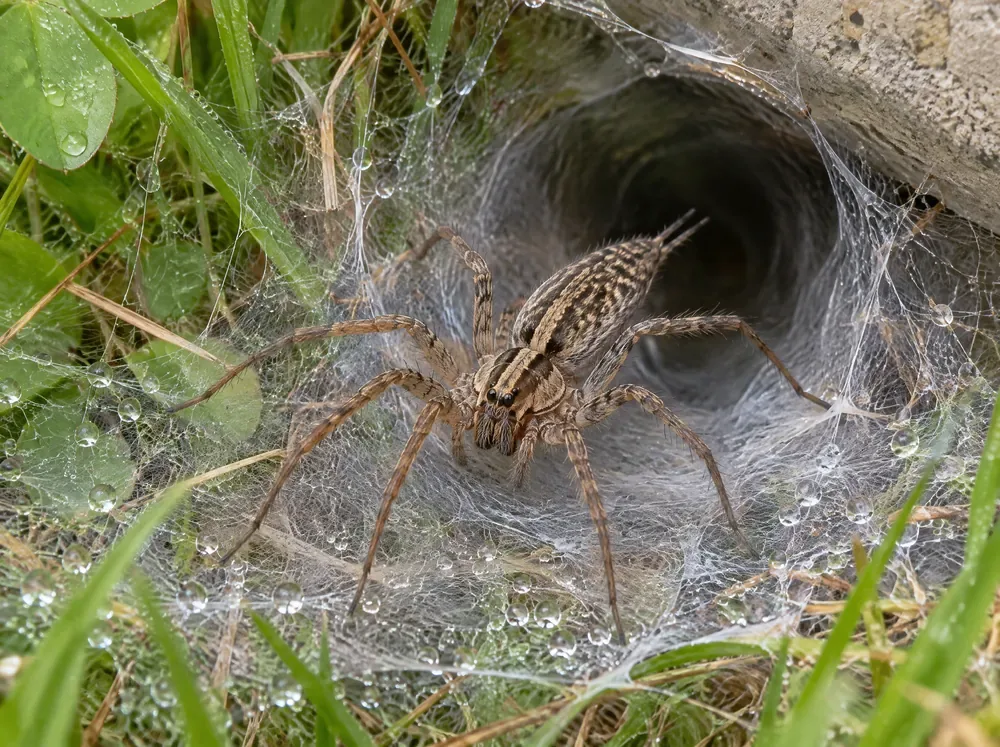
Grass spiders are members of the funnel-weaver family. The ones around Treasure Valley homes are usually species in the genus Agelenopsis. They are brown or gray-brown, with a long, tapering abdomen (often with a faint pattern) and long spinnerets you can sometimes see at the back. The clearest clue is the web: a dense, slightly sticky-looking sheet with a funnel or tube off to one side. The spider sits in that tube and runs out onto the sheet when an insect hits it.
These webs show up almost anywhere there is a low, protected edge — the lawn against a sidewalk, a rock bed, the gap at the bottom of a fence, or a window well. People notice them after a heavy dew or a light watering, when the sheets suddenly stand out. The spiders themselves are fast. That speed, plus the funnel, is why they get called hobo spiders so often.
Also a funnel weaver, but hobo spiders more often wander indoors in late summer and their webs are less obvious in open lawns. Identification of the two can take a close look. See the hobo spider guide.
Similar size and speed, but wolf spiders hunt on the ground without a sheet-and-funnel web and have a different eye pattern.
A different, very common cobweb spider in Treasure Valley homes. It builds a messy tangle web in a corner, not a sheet-and-funnel web in the lawn or a window well. See that guide.
Grass spiders are some of the most visible yard spiders in the Treasure Valley in late summer. Irrigated lawns, rock mulch and window wells around Eagle, Meridian and Boise homes give them plenty of insects and plenty of edges for a sheet web. You may also find webs against air-conditioning equipment, water-shutoff boxes and low shrubs.
They wander inside now and then, usually as a lone spider that walked in through a gap or was carried in with outdoor items, but they are outdoor spiders first. Indoor sightings pick up when the weather cools and when the outside population is at its peak. They are not a sign that the house is “infested” in the way ants or mice can be; they are following insects and cover.
Grass spiders are not considered dangerous to people or pets. They can bite if they are pressed against skin, and any bite can be irritating, but they are not the medically important spider in Idaho. That is the western black widow. This page is general information, not medical advice.
If grass-spider webs keep taking over window wells and the foundation line, or if the spiders keep ending up inside, we include that work in quarterly spider control. We treat the foundation, entry points and the low, protected spots where funnel webs form so fewer spiders and the insects they follow make it to the house. Quarterly plan customers get a free return visit if covered pests come back between visits. There are no contracts. We work family and pet safe. Treated areas are safe for kids and pets once they’re dry, usually about 15 to 20 minutes.
Learn more on our spider control page, or request a free quote.
More answers in our FAQ page.
Written by the ProGuard team from the sources above. Last updated: November 17, 2026. This page is general information, not medical advice. If you are worried about a sting, bite or your health, talk to a doctor.
Call, text or send a few details. We’ll give you a free quote before any work starts, and there are no contracts.
