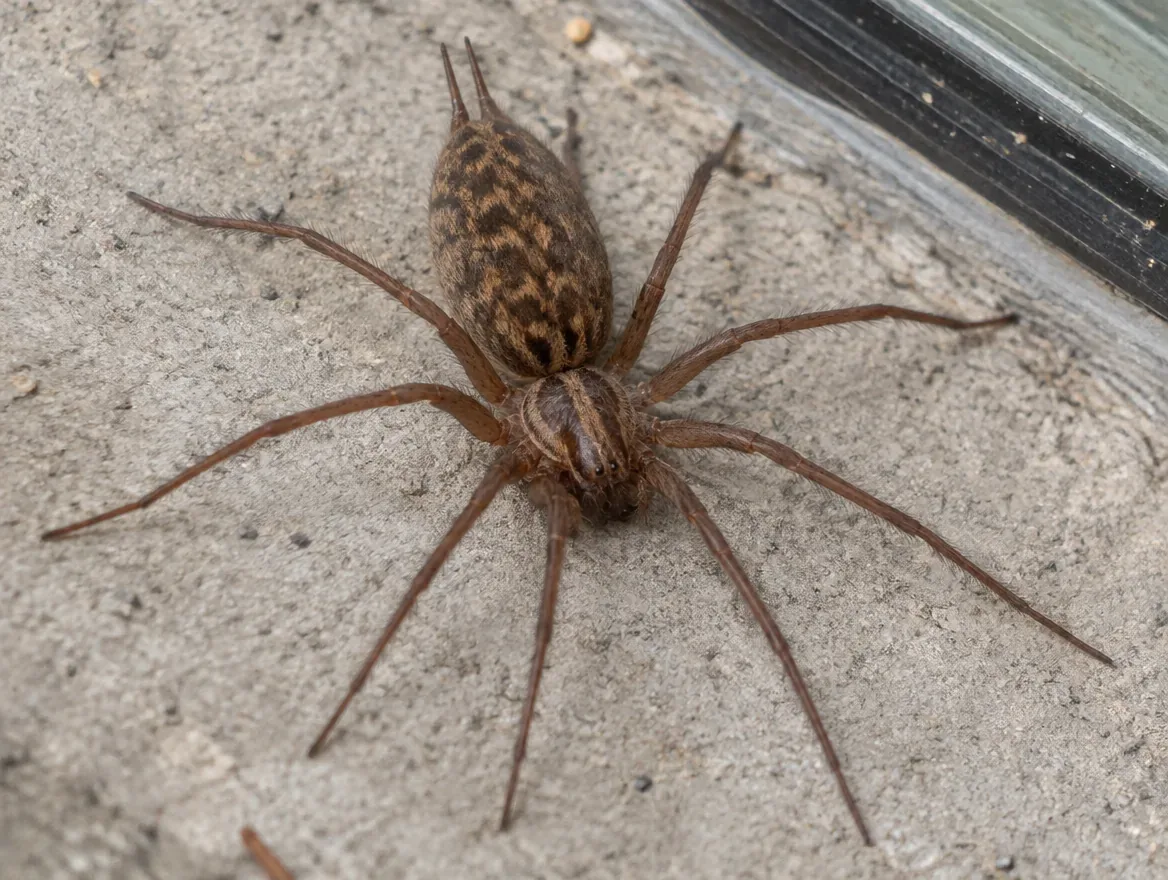
In short: the hobo spider is a common funnel web spider in Idaho, and the claim that its bite causes ulcerating wounds has been debunked. You usually see a lone male running across a ground level floor from mid July until the first hard fall frost. Positive identification needs a microscope, so many spiders called hobos are something else.
Hobo spiders are medium to large brown spiders in the funnel web family. Their legs are a plain tan brown with no pattern of darker or lighter bands. Under magnification the eight eyes sit in two slightly curved rows of four, and all eight are the same size. If some eyes are clearly larger than others, it is not a hobo spider.
Even so, many spiders have plain tan legs, and color and markings alone are unreliable. Species identification takes an expert with a microscope. They are also poor climbers, so a spider on a ceiling or high on a wall is probably not one. If you need a certain answer, collect the spider in a sealed container with rubbing alcohol and take it to your local University of Idaho Extension office.
Many spiders in the funnel web family look alike, build similar webs and wander indoors the same way. The web alone does not identify a hobo spider.
Hairy, with two big forward facing eyes above a row of four small ones. Wolf spiders hunt without webs.
Alternating dark and light marks on the legs mean it is not a hobo spider.
Outdoors, hobo spiders build funnel webs around low features with cracks and crevices, such as rock gardens, low shrubs, window wells and woodpiles, usually in dark, moist spots. Inside, they sometimes build webs in cluttered basements and crawl spaces where small insects are crawling.
Most people meet one as a lone spider running across a floor. Those are mostly mature males that wander inside looking for a mate from mid July through the first hard fall frost. Hobo spiders overwinter as eggs laid in the fall and as young spiders from the prior spring, and they mature after about two summers of growth.
The hobo spider came from western Europe, where it is a common and harmless house spider. It was first found in Seattle in the 1940s, reached Idaho in the late 1960s and was established statewide by the early 1990s.
For years the hobo spider was blamed for painful, ulcerating skin wounds. University of Idaho Extension now says that claim has been debunked, and UC IPM and WSU report that recent research has not shown the bite to be harmful. Like any spider, a hobo spider can bite if it is trapped against skin, but it is not considered a dangerous spider.
Many skin problems get blamed on spiders. If you have a wound that is not healing, see a doctor rather than assuming a spider is the cause.
Extension advice is to treat hobo spiders as a nuisance, not a danger. If they keep showing up inside after you have sealed and cleaned up, we treat the foundation, entry points and the low, protected spots where funnel webs form so fewer of them make it indoors.
Quarterly visits keep the protection up, and quarterly plan customers get a free return visit if covered pests come back between visits. There are no contracts. We work family and pet safe. Treated areas are safe for kids and pets once they’re dry, which is usually about 15 to 20 minutes.
Learn more on our spider control in the Treasure Valley page, or reach out through our contact page.

The one medically important Idaho spider, and how to spot its hourglass.
Western black widow guideAre they here? Facts, look alikes and misdiagnosed bites.
Brown recluse in Idaho guideAlso in this section: American house spider, Grass spider, False black widow. Local pages: Boise and Meridian.
Back to all all spiders in the Pest Library.
Written by the ProGuard team from the sources above. Last updated: November 17, 2026. This page is general information, not medical advice. If you are worried about a bite or your health, talk to a doctor.
Call, text or send a few details. We’ll give you a free quote before any work starts, and there are no contracts.