Local, family and veteran owned · Eagle, IDMon to Sat, 9 AM to 6 PM.
In short: yellowjackets, paper wasps, bald-faced hornets and mud daubers all nest around Treasure Valley homes. Nests start in spring and peak in late summer, when yellowjackets get aggressive near food and lawns. Wasp and hornet nests on and around your home are covered by ProGuard’s quarterly plan.
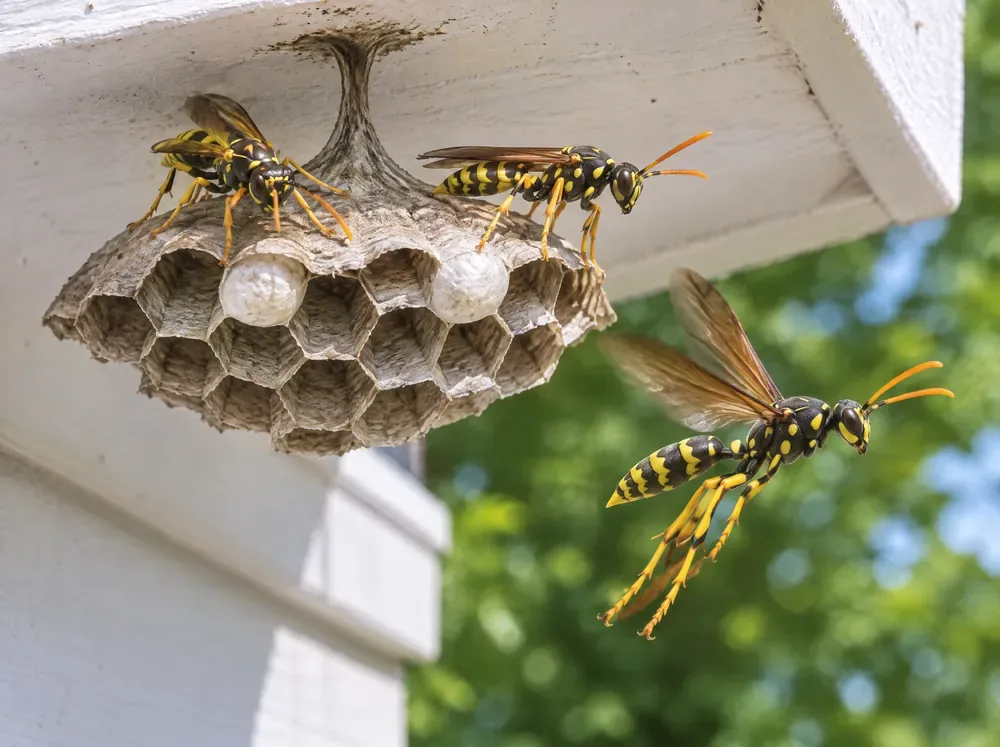
The aggressive late summer wasp at picnics, and its hidden nests.
Yellowjacket: signs and look alikesUmbrella shaped nests under eaves, and the slender wasps that build them.
Read about the paper waspWestern yellowjackets often nest in the ground and drive late-summer sting calls in the Treasure Valley.
Ground-nesting yellowjacket guideThe European paper wasp is the dominant paper wasp under Treasure Valley eaves.
European paper wasp: signs and look alikesTiming below is typical for the Treasure Valley, from Eagle, Middleton and Garden City to the rest of the valley. A warm spring or a long fall shifts it by a few weeks.
| Season | What we see |
|---|---|
| Spring (April to May) | Queens that spent the winter in sheltered spots start small nests under eaves, in sheds, in play sets and in old rodent holes in the lawn. |
| Early summer (June to July) | Nests grow fast. Paper wasp umbrella nests show up under eaves and railings, and mud daubers build tubes on walls and in garages. |
| Late summer (August to September) | Yellowjacket colonies peak and start scavenging around food, trash and patios. Ground nests in lawns and bald-faced hornet nests are at their largest. |
| Fall (October to first frost) | Colonies die off after hard frosts. New queens look for sheltered spots in attics, wall gaps and woodpiles. Old nests are not reused. |
Wasp and hornet nests on and around your home are covered by the quarterly plan. On each visit we check the eaves, soffits, railings, sheds and play sets where nests start, and we treat active nests we find.
Ground nests and nests inside walls need care, so we treat them at the entrance rather than opening them up. If a nest shows up between visits, call or text and we will come back for a free return visit. If someone has a known sting allergy, tell us when you call, and get medical help right away after a sting.
See what the quarterly plan covers and how residential pest control details works, or browse the rest of the Pest Library.
University of Idaho Extension notes that most wasps are beneficial predators of other insects, and many nests can be left alone when they are away from doors, play areas and walkways. Nests near people are a different story. Yellowjackets defend their nests hard, and a hidden nest in the ground or a wall can be stepped on or disturbed by accident.
Nests start small in spring with a single queen, so early season is the easiest time to deal with them. By late summer colonies are at their largest and workers are most aggressive around food.
Wasp and hornet nests on and around the house are covered by the quarterly plan. Call or text if a nest shows up between visits.
Quarterly visits keep the protection up, and quarterly plan customers get a free return visit if covered pests come back between visits. There are no contracts. We work family and pet safe. Treated areas are safe for kids and pets once they’re dry, which is usually about 15 to 20 minutes.
Learn more on our how our residential pest control works page, or request a free quote.
Yes. Wasp and hornet nests on and around your home are covered by the quarterly plan. If a nest shows up between visits, call or text 208-352-2062 and we will come back for a free return visit.
Late summer, usually August and September. Colonies are at their largest then and the workers scavenge around food, trash cans and patios.
Call, text or send a few details. We’ll give you a free quote before any work starts, and there are no contracts.
