Local, family and veteran owned · Eagle, IDMon to Sat, 9 AM to 6 PM.
In short: The American house spider is the everyday cobweb spider in Treasure Valley homes. It builds a messy tangle web in a corner, eave, window frame, garage or shed and sits in the web waiting for insects. It is very common in Eagle, Meridian and Boise houses year-round. It is not considered dangerous, and it is not a western black widow.
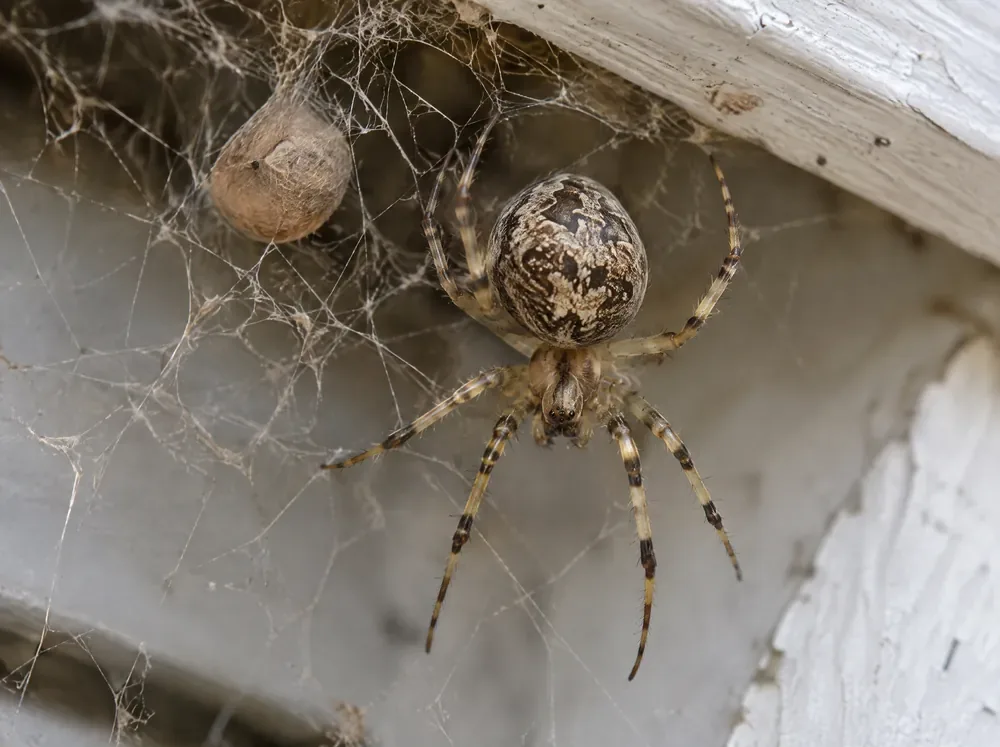
American house spiders (Parasteatoda tepidariorum, also called the common house spider) are medium-sized cobweb spiders. Females have a mottled gray-brown, somewhat bulbous abdomen, often with a vague pattern, and a smaller, darker cephalothorax. Males are slimmer. The web is the easy clue: a messy, irregular tangle in a sheltered corner, not a neat orb and not a flat sheet with a funnel.
They are the spiders most people already live with and never name. The web collects dust and insect remains, and the spider often hangs in the middle or hides at the edge. Color is variable, so it is a poor way to separate them from other cobweb spiders. A glossy black spider with a red hourglass on the underside is a western black widow, not this species. A dark, shiny cobweb spider without an hourglass may be a false black widow.
The one Idaho spider of medical importance. Mature females are glossy black with a distinct red hourglass on the underside. See that guide if you are not sure.
A darker, shinier cobweb spider without a red hourglass. It uses the same kind of messy corner web. See that guide.
Much longer, thinner legs and a small body in loose, messy webs, often in basements and garages. See that guide.
American house spiders are among the most common spiders in and around Treasure Valley homes. They live in eaves, porch corners, window frames, garages, sheds, basements and little-used rooms in Eagle, Meridian and Boise and the rest of the valley, all year. A house can have a few webs or a lot, depending on how many insects are around and how many sheltered corners there are.
They are outdoor and indoor spiders. A dusty cobweb under a patio cover or in a meter box is as typical as one in a garage ceiling corner. Unlike hobo spiders and grass spiders, they are not a late-summer floor runner story first — they are a cobweb-in-the-corner story. People notice them when webs accumulate, when a spider drops from a porch ceiling, or when they want to know if a dark spider in a messy web is a widow.
American house spiders are not considered dangerous to people or pets. They can bite if they are pressed against skin, and any bite can be irritating, but they are not the medically important spider in Idaho. That is the western black widow. If you have a wound that is not healing, see a doctor rather than assuming a spider caused it. This page is general information, not medical advice.
When cobwebs keep coming back around the eaves, garage and foundation, we include that work in quarterly spider control. We treat entry points and the sheltered corners and edges where cobweb spiders build, so fewer spiders and the insects they follow gather on the house. Quarterly plan customers get a free return visit if covered pests come back between visits. There are no contracts. We work family and pet safe. Treated areas are safe for kids and pets once they’re dry, usually about 15 to 20 minutes.
If you are worried a spider is a western black widow, we can help you compare what you are seeing. Learn more on our spider control page, or request a free quote.
More answers in our frequently asked questions.
Written by the ProGuard team from the sources above. Last updated: November 17, 2026. This page is general information, not medical advice. If you are worried about a sting, bite or your health, talk to a doctor.
Call, text or send a few details. We’ll give you a free quote before any work starts, and there are no contracts.
