Local, family and veteran owned · Eagle, IDMon to Sat, 9 AM to 6 PM.
In short: The most common late-summer sting complaint in the Treasure Valley is a yellowjacket colony nesting in the ground or in a low cavity. Western yellowjackets often take over an old rodent burrow in a lawn, play area or creekside bank.
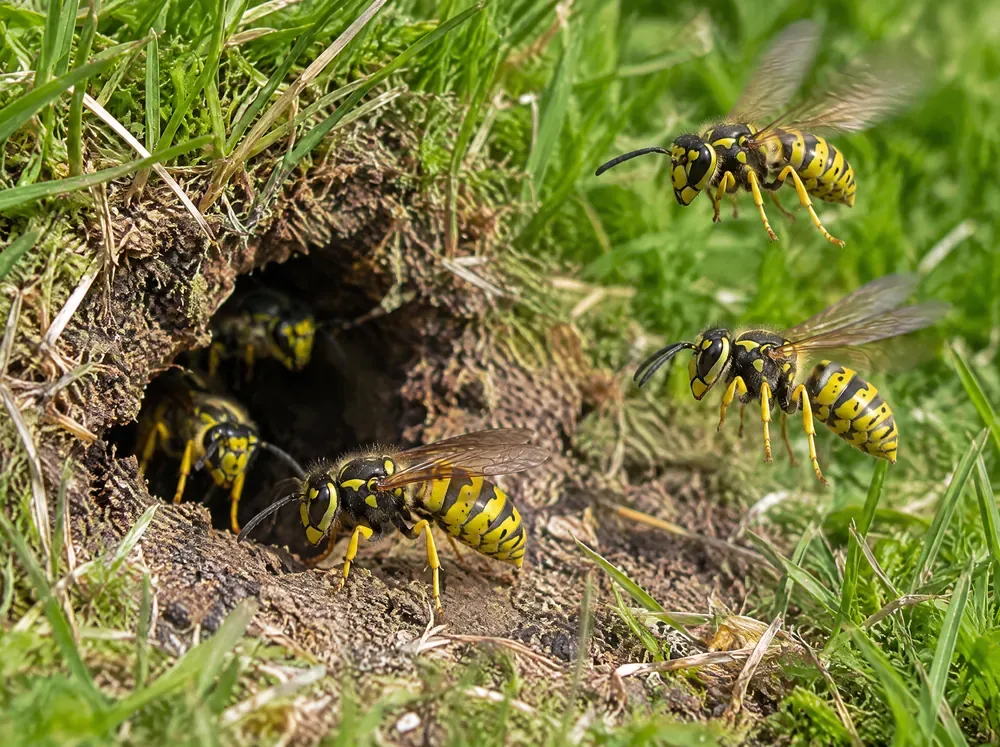
Western yellowjackets (Vespula pensylvanica) and some related Vespula species are the typical ground-nesting yellowjackets here. They are stocky black-and-yellow wasps, shorter and stouter than paper wasps, and they fold their wings along the body at rest. Foragers fly in and out of a hole in the lawn, at the edge of a sidewalk, in a rock bed, or in a bank — often an old mouse or vole burrow — with no obvious paper nest in view. The nest itself is underground.
Paper wasps build open-comb umbrellas under eaves. Bald-faced hornets build a large gray aerial carton nest in a tree or on a building. Those are different insects and different jobs, even though people call all of them “bees” or “hornets.” A ground nest is easy to miss until a mower, a dog or a bare foot comes too close.
Longer-legged, with orange antennae on many adults, and an open paper nest under an eave, not a hole in the lawn. See that guide.
Larger, black and white, with a gray aerial nest in a tree or on a structure.
Fuzzy, with a different color pattern, and they usually nest in a hive or cavity, not a small hole in a lawn.
Ground nests show up across the valley wherever there is soil, irrigation and a leftover burrow: lawns in Eagle and Meridian, creekside banks, playground edges, and the berms around new subdivisions. Activity starts quietly in early summer and becomes hard to ignore in August and September, which is also when yellowjackets crowd trash cans, pet food and outdoor meals.
Nests die out with cold weather, but that does not help a family that cannot use the backyard in September. New queens overwinter and start fresh colonies in spring, which is why this is a seasonal problem rather than a year-round indoor infestation.
Yellowjackets can sting repeatedly. Stings hurt, and some people have allergic reactions. If someone has trouble breathing, swelling of the face or throat, dizziness, or other serious symptoms, get emergency medical help. This page is general information, not medical advice.
Wasp and hornet nests are covered by our quarterly residential plan. If you have a ground nest, call or text us and we will plan the work around the nest location — these jobs need care, and we do not treat a ground nest as a casual job. Quarterly plan customers get a free return visit if covered pests come back between visits. There are no contracts. We work family and pet safe and follow label directions.
If yellowjackets are a late-summer problem around the house, the regular quarterly visits also help with the other pests of the season. Request a free quote, or call or text 208-352-2062.
More answers in our pest control FAQ.
Written by the ProGuard team from the sources above. Last updated: November 17, 2026. This page is general information, not medical advice. If you are worried about a sting, bite or your health, talk to a doctor.
Call, text or send a few details. We’ll give you a free quote before any work starts, and there are no contracts.
