Local, family and veteran owned · Eagle, IDMon to Sat, 9 AM to 6 PM.
In short: the bald faced hornet is a large black and white wasp, actually an aerial yellowjacket, that builds a gray paper nest the size of a football or bigger in trees, shrubs and on eaves. The nest is closed with one entrance near the bottom.
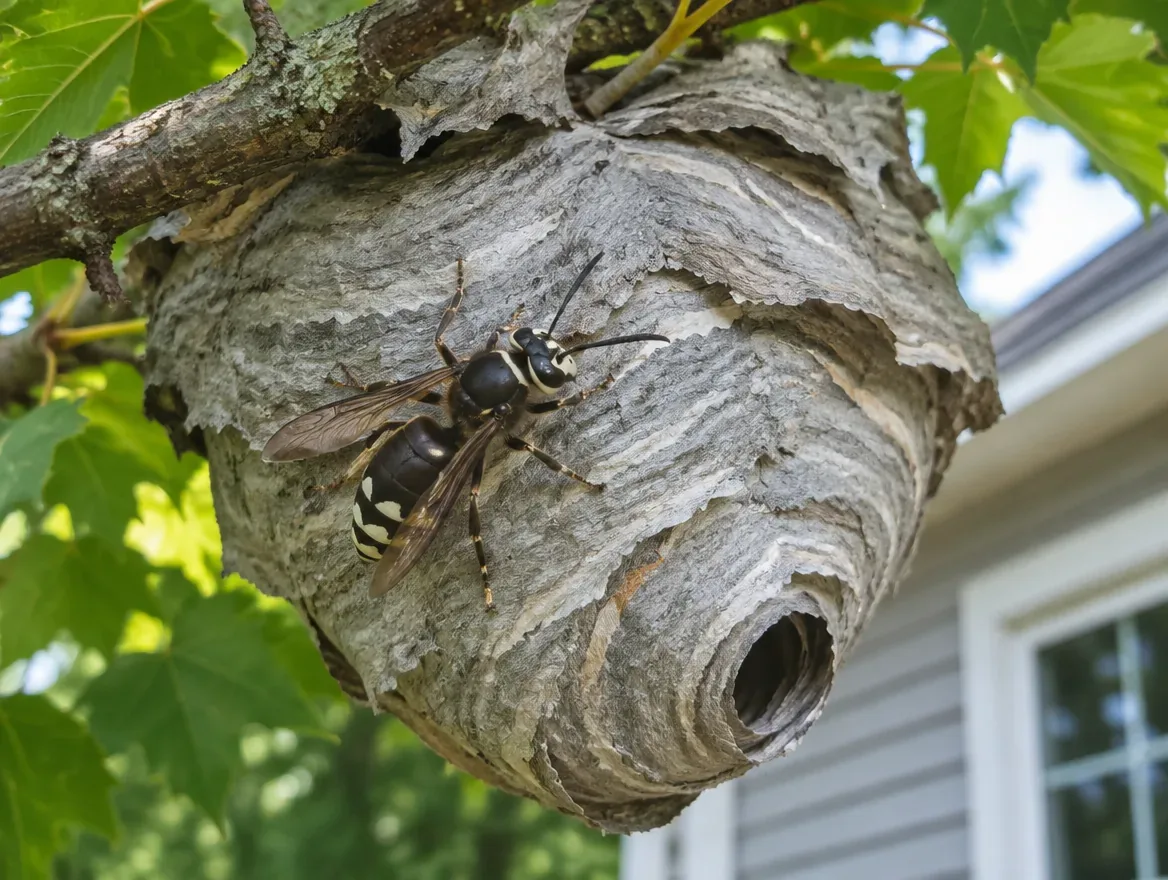
Bald faced hornets are easy to pick out once you know them. Instead of yellow, they are black with bright white marks on the face and at the end of the body. They are bigger than most yellowjackets and have the same short waist and stocky build.
The nest is what most people notice first, often after the leaves fall. UC IPM says this species builds paper nests that attach to the eaves of a building or hang from a tree limb. The outside is layered gray paper, swirled like a seashell, with one opening near the bottom. By late summer some nests are as big as a basketball.
Their nests are small, open combs you can see into, with no paper wrapping.
Yellow and black, and their nests are hidden in the ground or in walls.
Thin, dark, solitary wasps that build small mud tubes, not paper nests.
A queen starts the nest alone in spring, usually several feet or more off the ground in a tree, a hedge or under an eave. The colony grows through summer and can number in the hundreds. Like other yellowjackets, the colony lasts one season. Workers die in fall and only new queens survive the winter in protected spots.
Many people never see the nest until fall, when the leaves drop and a big gray ball shows up in the tree by the driveway. By then it is usually empty or close to it, and an empty nest is not reused.
They can be. Bald faced hornets defend the nest strongly and will chase someone who bumps the branch, mows next to the hedge or sprays the nest. Each hornet can sting more than once. Away from the nest they are usually busy hunting other insects and leave people alone.
If someone is stung and has trouble breathing, or swelling of the face, lips or throat, call 911. For a sting that swells a lot or gets worse, call a doctor.
An active bald faced hornet nest near a door, a deck or a walkway is a job for a professional. We wear protective gear, treat the nest at the entrance and remove it once the hornets are gone.
Quarterly visits keep the protection up, and quarterly plan customers get a free return visit if covered pests come back between visits. There are no contracts. We work family and pet safe. Treated areas are safe for kids and pets once they’re dry, which is usually about 15 to 20 minutes.
Learn more on our what residential pest control includes page, or use our online quote form.
The aggressive late summer wasp at picnics, and its hidden nests.
Read about the yellowjacketSee what the service includes and how it works.
Residential pest control in the Treasure ValleyAlso in this section: Ground-nesting yellowjacket, European paper wasp. Local pages: Garden City and Middleton.
Back to all wasps and hornets in Idaho.
Written by the ProGuard team from the sources above. Last updated: November 17, 2026. This page is general information, not medical advice. If you are worried about a bite or your health, talk to a doctor.
Call, text or send a few details. We’ll give you a free quote before any work starts, and there are no contracts.
