Local, family and veteran owned · Eagle, IDMon to Sat, 9 AM to 6 PM.
In short: Field ants are Formica ants that nest in soil in yards and along sidewalks and occasionally wander inside looking for food or water. They are larger than pavement ants and odorous house ants. Their nests are outdoor mounds or soil craters, not wall-void colonies like some indoor ants.
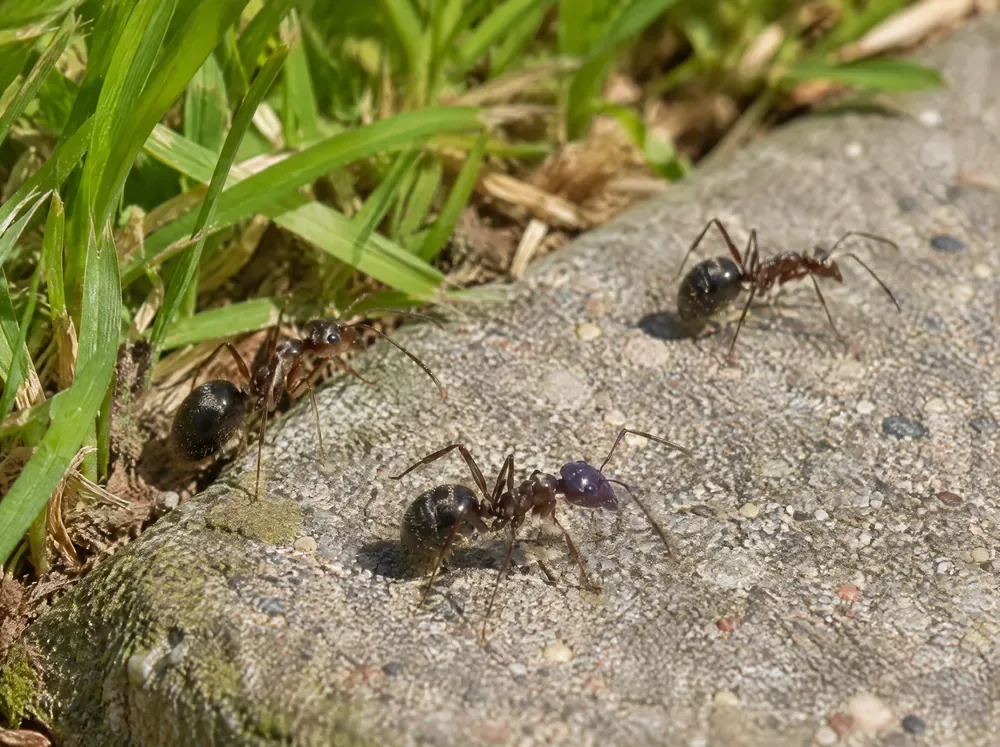
Field ants are a group of Formica species, medium to large, in colors from reddish brown to black, sometimes two-toned. They nest in soil. You may see a low crater or a small mound in the lawn, along a driveway, next to a sprinkler head or under a rock or landscape timber. Workers trail from that nest into the yard and, now and then, across a threshold.
They get mixed up with pavement ants because both can appear along walkways, and with thatching ants because both are Formica. Field-ant mounds are usually smaller and have less plant thatch than a true thatching-ant nest. Crushing an odorous house ant gives a strong rotten-coconut smell; field ants do not. Getting the group right matters because the nest is almost always outside, even when a few workers show up on a kitchen counter.
Smaller, dark, and they smell like rotten coconut when crushed. They often nest closer to the house and in wall voids near moisture.
Smaller, with fine grooves on the head and thorax, pushing fine soil from cracks in slabs and sidewalks.
A Formica group that builds larger mounds of twigs and grass, more often in foothill or native ground.
Field ants are ordinary yard ants across the Treasure Valley. Irrigated turf in Eagle, Star and Middleton, new subdivision soil, and the edges of sidewalks and patios all give them nesting sites. They are most active in spring and summer. After a watering or a warm spell you may see a flush of workers or a little fresh soil on the mound.
Indoor visits are usually brief: a trail under a sliding door, a few ants on a patio that found a spill, or foragers after a rain that drove them to a new edge. That is different from odorous house ants, which may set up inside. If ants are consistently in the kitchen, we identify them before we treat, because the nest location changes the work.
Field ants may bite if a nest is disturbed. They are not treated as a medically important ant in the Treasure Valley. If a bite causes serious symptoms, get medical help.
We treat field ants as outdoor-nesting yard ants. On a quarterly visit we look at the foundation, the slab edges and the mounds or craters close to the house, and we use ant treatments and bait that fit a soil-nesting Formica colony. If the ants in the kitchen turn out to be odorous house ants instead, we treat that nest pattern instead. Quarterly plan customers get a free return visit if covered pests come back between visits. There are no contracts. We work family and pet safe. Treated areas are safe for kids and pets once they’re dry, usually about 15 to 20 minutes.
Learn more on our ant control page, or request a free quote.
More answers in our FAQ page.
Written by the ProGuard team from the sources above. Last updated: November 17, 2026. This page is general information, not medical advice. If you are worried about a sting, bite or your health, talk to a doctor.
Call, text or send a few details. We’ll give you a free quote before any work starts, and there are no contracts.
