Local, family and veteran owned · Eagle, IDMon to Sat, 9 AM to 6 PM.
In short: Thatching ants are large Formica ants that build mounds of twigs, grass and other plant bits in native ground and foothill yards. They can bite and spray formic acid if the nest is disturbed. They are a foothill-yard problem more often than a kitchen-trail problem.
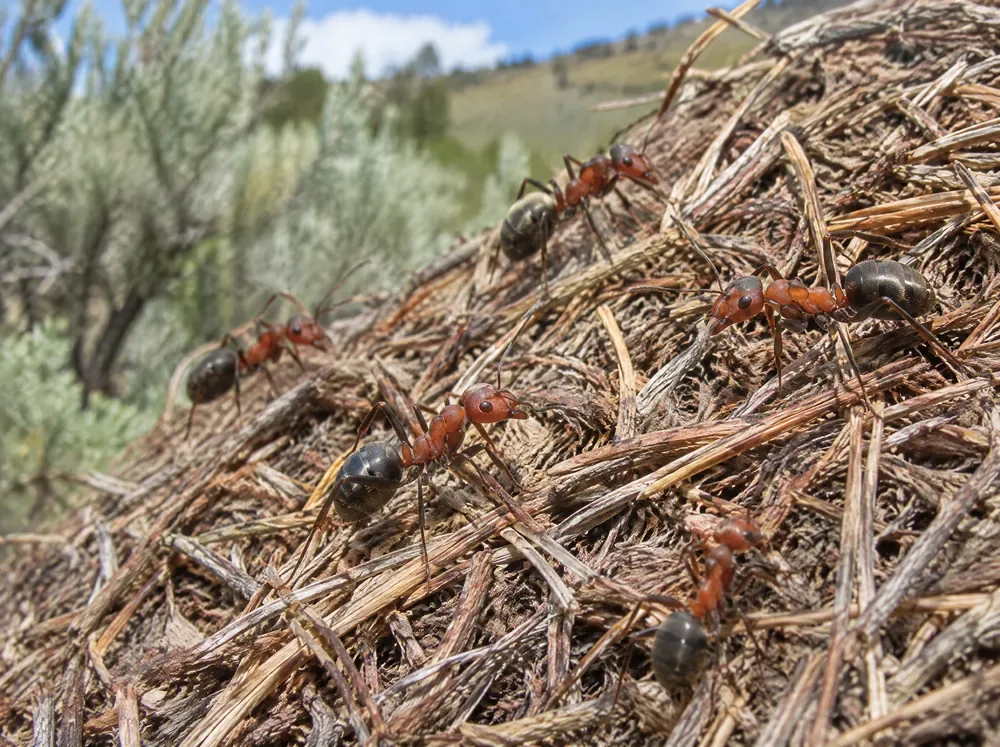
Western thatching ants (Formica obscuripes and closely related Formica species) are good-sized ants, often red and black or dark brown, and they live in obvious mounds. The mound is the giveaway: a dome or low pile of thatch — bits of grass, twigs and needles — sometimes a foot or more across, in open or partly sunny ground. Trails can run from the mound into nearby landscaping or along a sidewalk.
They are not the same ant as the pavement ant that nests under slabs, and they are not the harvester ant that University of Idaho describes as mostly a rangeland ant that only rarely nests around homes. Thatching ants are the mound builders we hear about more often along the Eagle and Emmett foothills, where native ground still sits next to new landscaping.
Also large and noticeable, with gravel clearings around a hole more often than a thatch mound. University of Idaho describes them as mostly rangeland ants that only rarely nest around homes. See the harvester ant guide.
Other Formica ants that nest in soil in yards and sometimes wander indoors. Their mounds are usually smaller and less “thatched.”
Much smaller, nesting under slabs and along sidewalks, with fine soil pushed from cracks — not a thatch mound.
Thatching ant mounds show up in the drier, more native ground at the edge of the valley: Eagle foothill lots (including communities such as Avimor, Dry Creek Ranch, Valnova and Hidden Springs), Emmett-area yards, and other homes where sagebrush or native grass still meets irrigated turf. The ants prefer sun and open ground for the mound, then forage into landscaping.
They are most noticeable in spring and summer, when the mounds are active and winged ants may appear. Indoor sightings are usually a few foragers that came in under a door, not a nest in the wall. People often first notice them when someone steps near a mound or when a mower or dog finds it.
Thatching ants can bite and spray formic acid. That can hurt and can irritate skin, especially if a mound is kicked or mowed. They are not treated like the medically important sting of some other ants found outside this region. If someone has trouble breathing, swelling beyond the bite, or other serious symptoms, get medical help. This page is general information, not medical advice.
When thatching ant mounds sit close to a house, play area or walkway in the Eagle or Emmett foothills, we treat them as part of residential ant control on the quarterly plan. We look at the mound, the trail to the foundation and the entry points, and we use ant work that fits a mound-nesting Formica colony — including bait where that is the right tool. Quarterly plan customers get a free return visit if covered pests come back between visits. There are no contracts. We work family and pet safe. Treated areas are safe for kids and pets once they’re dry, usually about 15 to 20 minutes.
If you live in the Eagle foothills, you can also read our notes on those communities on the Eagle pest control page. Learn more on our ant control page, or request a free quote.
More answers in our pest control FAQ.
Written by the ProGuard team from the sources above. Last updated: November 17, 2026. This page is general information, not medical advice. If you are worried about a sting, bite or your health, talk to a doctor.
Call, text or send a few details. We’ll give you a free quote before any work starts, and there are no contracts.
