Local, family and veteran owned · Eagle, IDMon to Sat, 9 AM to 6 PM.
In short: harvester ants are large, reddish brown seed gatherers that build a low mound in a bare patch of ground, mostly on open rangeland and at the edge of newer Treasure Valley subdivisions. Their sting really hurts. Ant control is part of ProGuard’s quarterly plan, and we treat nests close to where people and pets play.
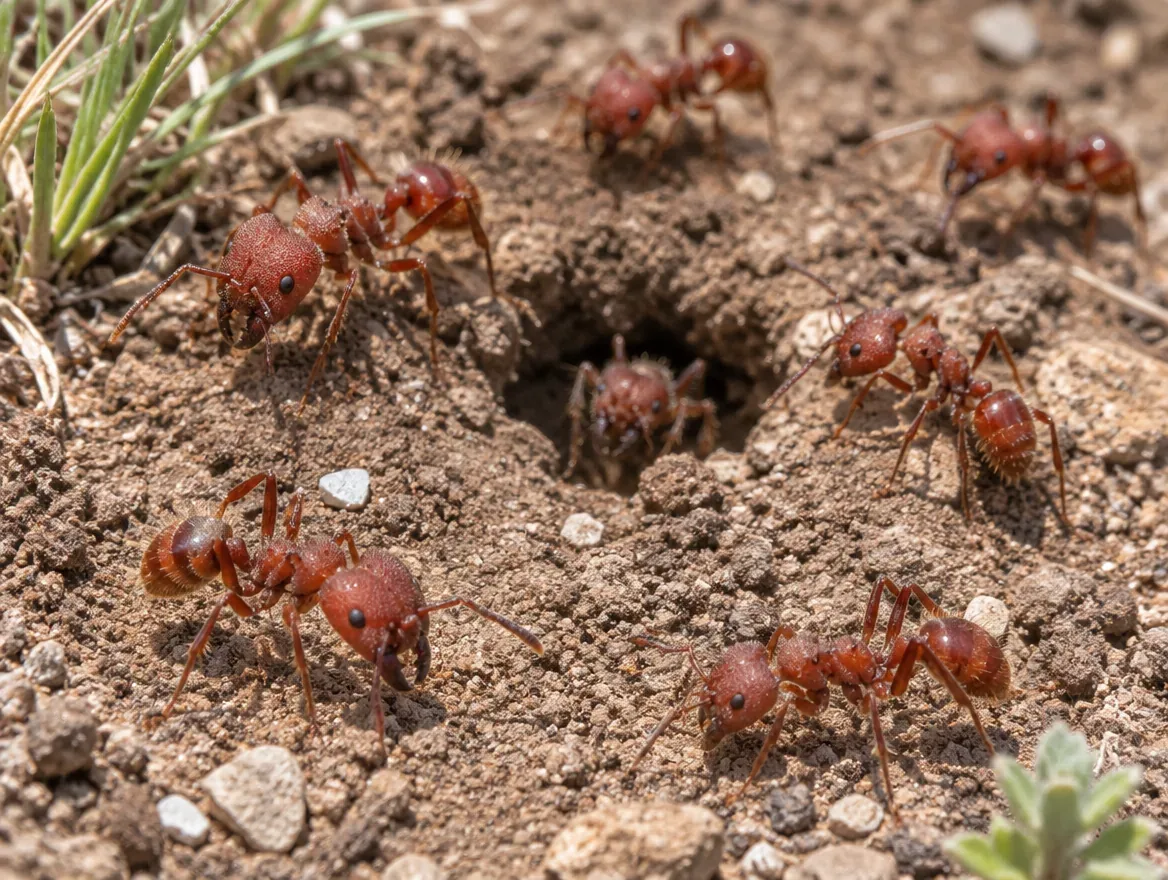
These are some of the largest ants you will see in Idaho, up to about 3/8 inch, and most are a reddish brown. Under a magnifier they have a distinctive fringe of long hairs under the chin, which helps them dig. They have two waist segments and are all about the same size.
The nest gives them away. Harvester ants clear the plants from a wide circle of ground around the colony’s entrance, leaving bare dirt with a low, flat mound in the middle that is often about 6 inches tall. You will often see a scattering of pebbles around the hole, and wide trails of workers leading out through the grass to gather seeds.
Several harmless Idaho ants also build mounds and look a little like harvester ants, but their mounds are not surrounded by a big patch of bare soil.
Much smaller, brown, and found in cracks, with little piles of sand along patios and driveways rather than a cleared circle.
University of Idaho Extension says harvester ant nests almost always sit in open, unshaded, dry soil, especially on Idaho rangeland, and only rarely around homes. A WSU, OSU and University of Idaho ant guide adds that these ants nest in sandy soil of a particular texture, and that the most colonies in the Pacific Northwest are found along the Snake and Columbia river areas.
That is why people usually get stung while picnicking, fishing, hiking or rock hounding, rather than in the kitchen. Winged ants swarm in spring. Extension from the University of Nevada, Reno adds that colonies can live 15 to 20 years, so a nest does not just go away.
University of Idaho Extension calls it the only ant sting in Idaho homes and landscapes that poses a significant hazard, and calls it intensely painful. The risk is low in practice, because the nests are easy to see and avoid. A WSU, OSU and University of Idaho guide compares the sting to a honey bee or yellowjacket and says few people are stung. It is not a serious problem unless someone has an allergic reaction. University of Nevada, Reno Extension says allergic reactions are uncommon, but people allergic to other insect stings should be careful.
If someone has trouble breathing, hives or swelling beyond the sting site, call 911.
Harvester ants are the one ant where it pays to look at the nest before doing anything. If a nest is close to a play area, dog run, patio or garden, we find it and treat it. If it is far from where your family spends time, we will tell you honestly that leaving it alone is an option, which is what Extension advises.
Quarterly visits keep the protection up, and quarterly plan customers get a free return visit if covered pests come back between visits. There are no contracts. We work family and pet safe. Treated areas are safe for kids and pets once they’re dry, which is usually about 15 to 20 minutes.
Learn more on our how our ant control works page, or send us a few details online.
The most common ant in Idaho homes, and the rotten coconut smell.
Odorous house ant guideThe one medically important Idaho spider, and how to spot its hourglass.
Western black widow facts for IdahoAlso in this section: Thatching ant, Field ant, Pharaoh ant. Local pages: Meridian and Nampa. In the foothills, see our notes on Eagle foothills communities such as Avimor and Dry Creek Ranch.
Back to all ants in Idaho.
Written by the ProGuard team from the sources above. Last updated: November 17, 2026. This page is general information, not medical advice. If you are worried about a bite or your health, talk to a doctor.
Call, text or send a few details. We’ll give you a free quote before any work starts, and there are no contracts.
