Local, family and veteran owned · Eagle, IDMon to Sat, 9 AM to 6 PM.
In short: Camel crickets are wingless, humpbacked crickets that live in cool, damp, dark places: crawl spaces, basements, well pits and cluttered storage. They jump suddenly when disturbed, which startles people, but they do not sting and they are not a pantry pest. They are a moisture-and-cover insect, closely related in habit to the field and house crickets already in our library.
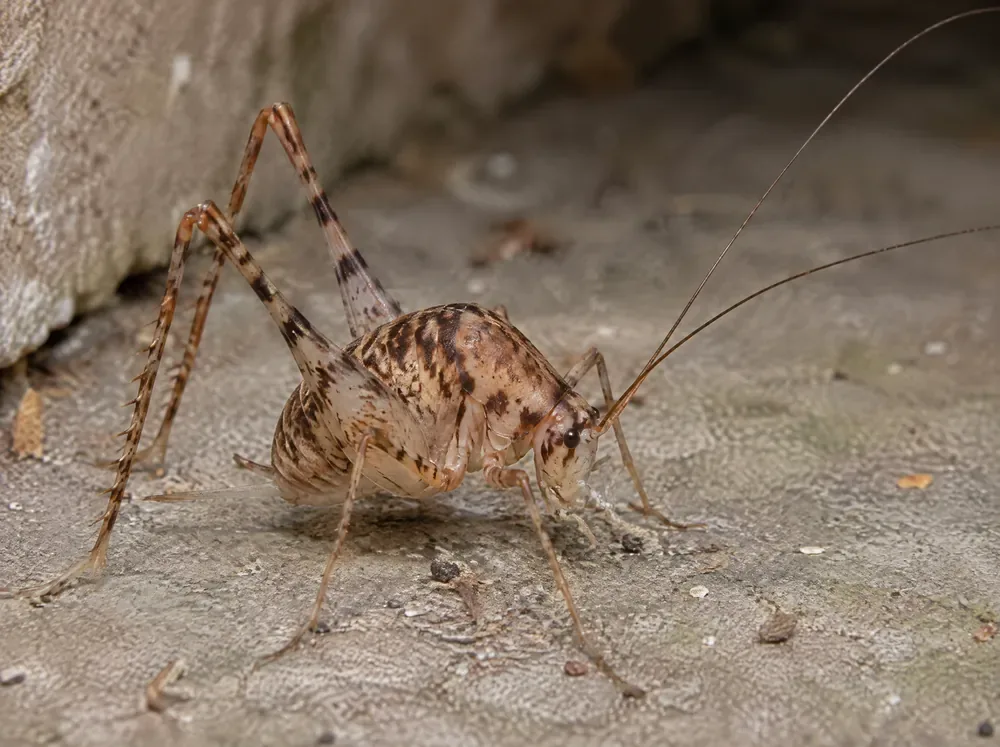
Camel crickets (family Rhaphidophoridae) have a high, arched back, long antennae, and powerful hind legs. They have no wings, so they do not chirp the way a house cricket does. Color is usually light brown to mottled tan. Some homes have the greenhouse or “camel” cricket (often Diestrammena asynamora, an introduced species that does well indoors); native Ceuthophilus species live in similar damp sites.
The usual field cricket or house cricket has a flatter body and wings, and the song gives it away. Camel crickets are silent and look almost spider-like to some people because of the long legs and antennae, but they are crickets, not spiders.
Winged, flatter body, and they chirp. See the cricket guide.
Camel crickets have six legs and long, cricket-style antennae, not eight legs.
If you think you have roaches, call and ask. Roach control is not part of the quarterly plan; we’ll give you a free quote. Camel crickets are humpbacked jumpers, not flattened roaches.
Camel crickets thrive in the damp edge of a Treasure Valley house: a crawl space, a basement that stays cool, a window well, or a cluttered storage room. Eagle and Boise homes with enclosed crawl spaces, and any house with a chronic moisture issue, see them most often. They come out at night and jump toward or past a person when the light comes on, which is usually how they get noticed.
They feed on organic debris and sometimes on fabric or paper that has been left in a damp place, but they are not a typical pantry insect. Moisture and cover are the conditions that support them.
When camel crickets keep appearing, we treat the crawl space, basement edge, window wells and the damp foundation line as part of quarterly service, and we look at the conditions that are supporting them. Quarterly plan customers get a free return visit if covered pests come back between visits. There are no contracts. We work family and pet safe. Treated areas are safe for kids and pets once they’re dry, usually about 15 to 20 minutes.
Request a free quote, or call or text 208-352-2062.
More answers in our frequently asked questions.
Written by the ProGuard team from the sources above. Last updated: November 17, 2026.
Call, text or send a few details. We’ll give you a free quote before any work starts, and there are no contracts.
