Local, family and veteran owned · Eagle, IDMon to Sat, 9 AM to 6 PM.
In short: Firebrats are carrot-shaped, bristletail insects that look like mottled silverfish but prefer hotter, drier sites: water-heater closets, boiler rooms, warm attics and the area around a furnace. They feed on starchy and protein materials. They do not sting. They are the warm-room counterpart to the silverfish already in our library.
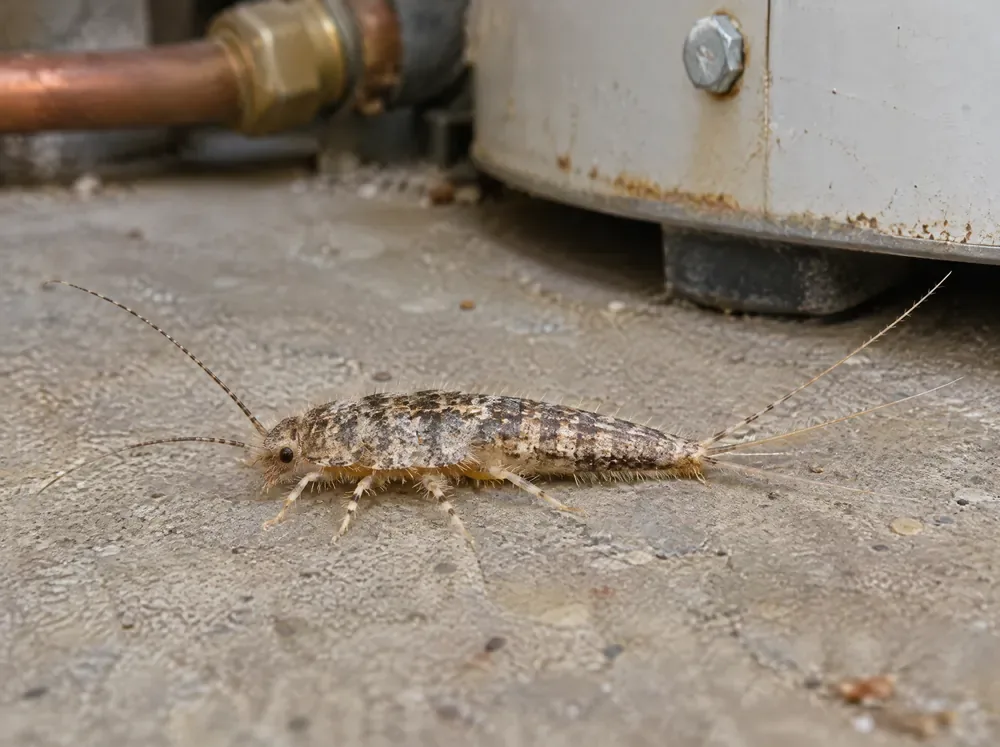
Firebrats (Thermobia domestica) have a flattened, tapering body, long antennae, and three tails at the back — the same body plan as a silverfish. They are mottled gray-brown rather than uniformly silvery, and they move quickly in a warm cupboard or along a baseboard near a water heater. Silverfish prefer cooler, damper rooms such as bathrooms and basements. That temperature preference is the practical way to tell them apart when you find one in a Treasure Valley house.
Both can feed on paper, glue, book bindings, crumbs and some fabrics. Finding one insect is common. Finding them regularly in a utility room usually means the warm site is supporting a small population.
The closest relative. More uniformly silvery, and more often in bathrooms, basements and sinks. See that guide. The work around the house is similar, but the site we look at first is different.
Dark, with pincers at the back, and usually coming from outdoors. See the earwig guide.
Much smaller, pale, and associated with humid storage, not a 1/2-inch bristletail.
Firebrats show up in the warm core of a house or business: the water-heater closet, a utility room that stays hot, a boiler room, or a tight attic in summer. Eagle, Meridian and Boise homes with an interior water heater are typical. They are less of a bathroom insect than silverfish are.
They are indoor insects in this climate, not yard insects that wander in after watering.
When firebrats persist in a utility room, we treat the warm sites they use and include that work in quarterly service, along with the rest of the house. If what you have is actually silverfish in a bathroom or basement, note that silverfish are not covered by the quarterly plan. Quarterly plan customers get a free return visit if covered pests come back between visits. There are no contracts. We work family and pet safe. Treated areas are safe for kids and pets once they’re dry, usually about 15 to 20 minutes.
Request a free quote, or call or text 208-352-2062.
More answers in our FAQ page.
Written by the ProGuard team from the sources above. Last updated: November 17, 2026.
Related in this section: Boxelder Bugs.
Call, text or send a few details. We’ll give you a free quote before any work starts, and there are no contracts.
