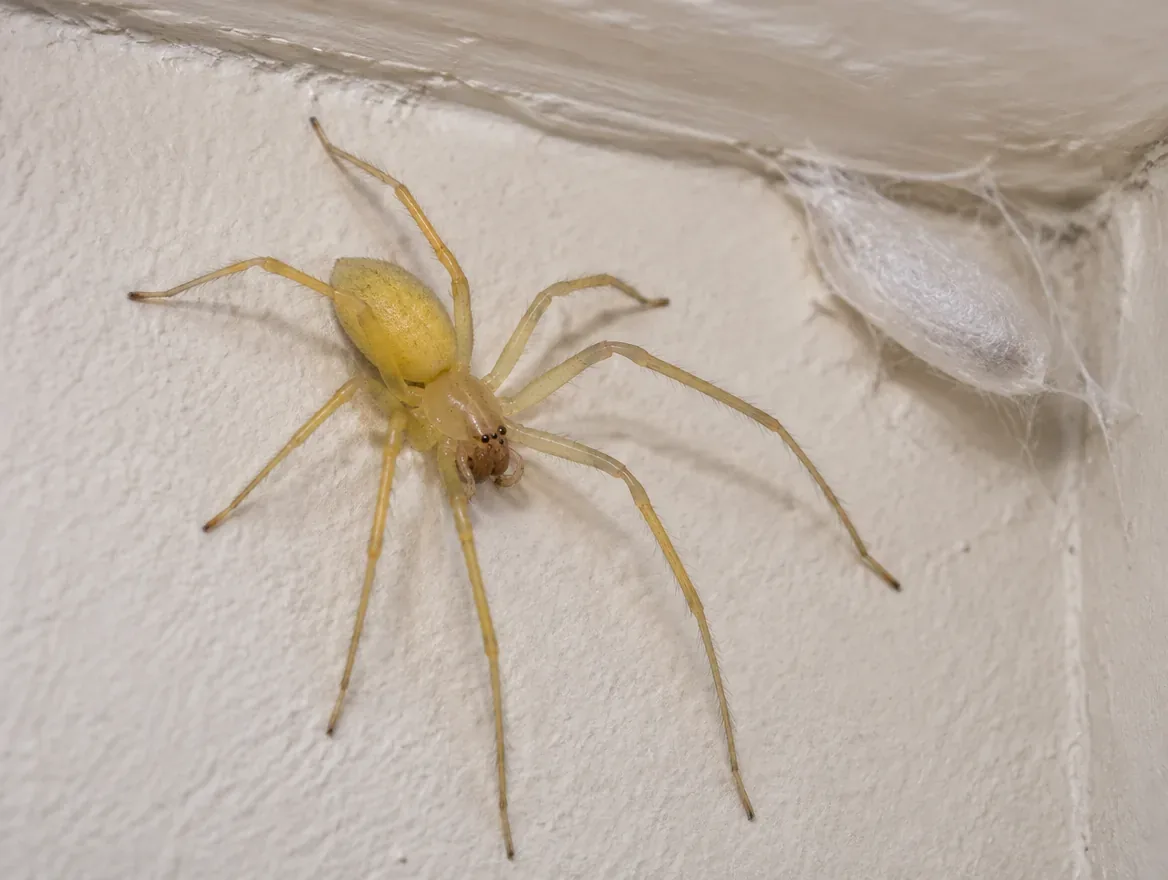
In short: sac spiders are small, pale yellow to beige spiders that hunt at night and rest in silk sacs. They can wander into homes. A bite feels about like a bee sting and leaves a red, itchy welt for a day or so, and no deaths are known. Claims that the bite causes dead tissue are not backed by research.
Sac spiders are small, pale spiders, yellow to beige, with a smooth, slightly shiny look. They are hunters rather than web builders. Instead of a capture web they build silken, sac shaped hiding places, often folded into a rolled leaf, under a rock, or in a ceiling or wall corner indoors.
Two species occur in the United States: the native yellow sac spider and the long legged sac spider, which was brought from Europe. Both are active at night and are often found hunting in grass and gardens, where they are helpful predators of insects.
Also pale, but with extremely long, thin legs and a loose, tangled web.
Active by day, compact, with two big forward facing eyes.
Many small tan or pale spiders look similar. A sealed specimen can be identified by UI Extension.
Outdoors, sac spiders live in grasslands and gardens and tuck into rolled leaves or under rocks. They mate in late spring and their egg sacs develop in June and July. Adults typically overwinter as adults or subadults.
Because they are active hunters, they can wander into homes and workplaces. Indoors you may find a small silk sac in a corner where the wall meets the ceiling. People are usually bitten when a spider is trapped against skin, for example in clothing or bedding.
Sac spiders are thought to be mildly venomous. University of Idaho Extension says the venom has been called necrotic, but there is no definitive research to verify that claim. Known symptoms are mild: a sting like a bee’s, followed by a red, itchy welt that lasts about a day. UC IPM cites a 2006 study of verified sac spider bites titled “Where is the necrosis?”. No human deaths are known.
If a bite swells, spreads or gets worse over a few days, see a doctor. Many skin problems, including bacterial infections, are mistaken for spider bites.
Because sac spiders hunt at night and slip in through small gaps, the best results come from sealing and from treating the outside of the house. We focus on entry points, eaves, door and window frames and the plants and debris along the foundation.
Quarterly visits keep the protection up, and quarterly plan customers get a free return visit if covered pests come back between visits. There are no contracts. We work family and pet safe. Treated areas are safe for kids and pets once they’re dry, which is usually about 15 to 20 minutes.
Learn more on our how our spider control works page, or reach out through our contact page.

Are they here? Facts, look alikes and misdiagnosed bites.
Brown recluse in Idaho guideAlso in this section: American house spider, Grass spider, False black widow. Local pages: Boise and Meridian.
Back to all all spiders in the Pest Library.
Written by the ProGuard team from the sources above. Last updated: November 17, 2026. This page is general information, not medical advice. If you are worried about a bite or your health, talk to a doctor.
Call, text or send a few details. We’ll give you a free quote before any work starts, and there are no contracts.