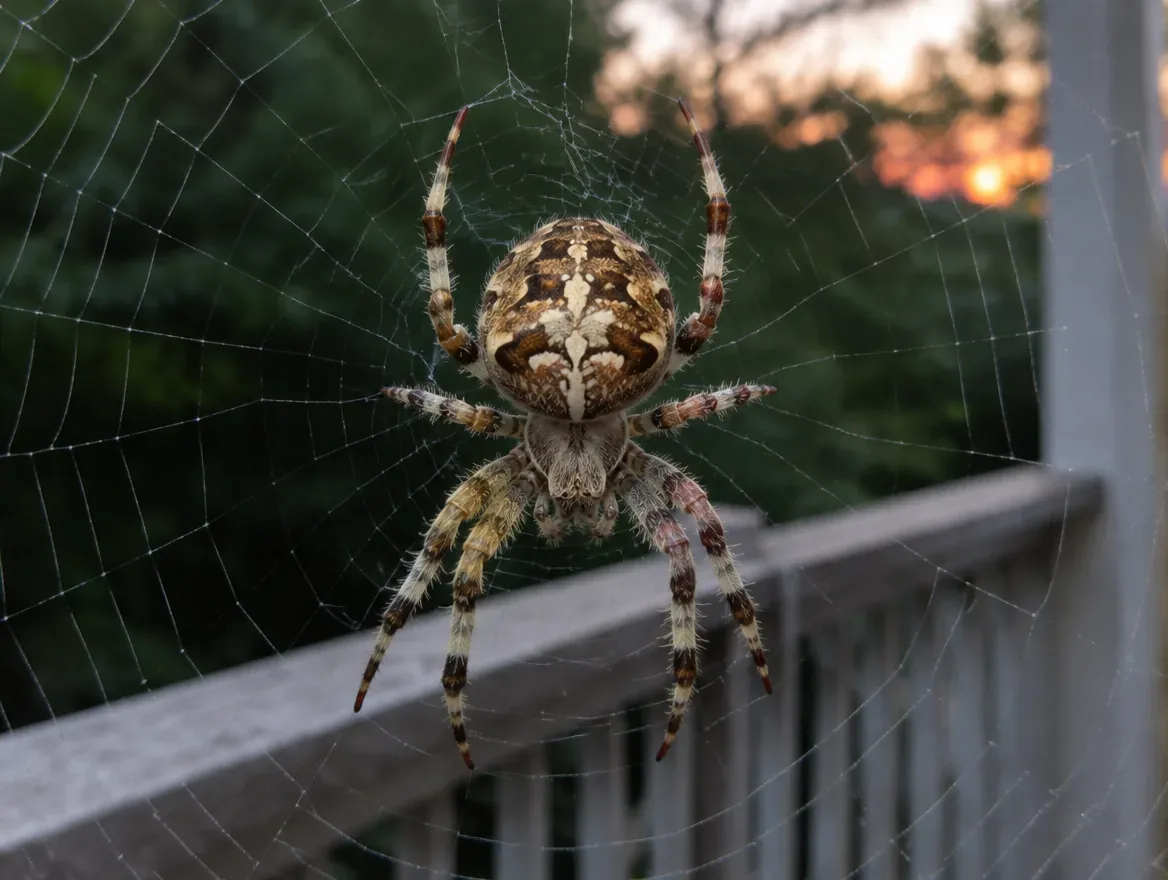
In short: orb weavers are the spiders behind the big, round, bull’s eye webs under eaves, on porch corners and across garden paths. They are common around Idaho homes, they are harmless to people and they eat flying insects. They almost never come indoors, so the usual fix is to wash the webs down and turn off lights that draw their food.
The web is the giveaway. An orb weaver spins a round, upright web that looks like a wheel: rings of silk that spiral out from the middle, with straight threads running out from the hub like spokes. The silk is sticky and catches whatever flies into it. These spiders do not see well. They wait at the center or hide in a sheltered spot at the edge and feel for the shake of a trapped insect.
The spiders themselves vary a lot. Many have a large, rounded abdomen with color or odd bumps, and short, thick legs with spines. One group is nicknamed cat faced spiders because of the pointed bumps on the back of the abdomen. Another is the garden spider, which is black with yellow and silver and sits in the middle of a web that can be two feet wide.
Their webs are flat sheets that narrow into a tube where the spider hides, not a round wheel. The hobo spider is the best known one in Idaho.
Black widows and their relatives build a messy, tangled web, usually low and in a dark spot. An orb weaver’s web is neat, round and upright.
Tiny spiders, about 1/8 inch, that spin flat layers or little domes of silk close to the ground. Their webs show up on dewy mornings.
University of Idaho Extension describes orb weavers as common in home landscapes. They string webs between shrubs and tall weeds, across garden paths and under eaves. Porch lights are a favorite spot, because the moths and other night flying insects that circle the light are an easy meal. The spider usually tucks itself in a protected place at the side of the web during the day.
Most orb weavers stay outdoors. Extension notes that they rarely build webs inside homes and are clumsy crawlers once they leave the web, so they do not wander in the way ground hunters do. Late summer and early fall is when you notice them most, because the spiders have grown to full size and the webs are big.
No. University of Idaho Extension says garden spiders, the large orb weavers people fear most, pose no special threat to health. They rarely bite, and when they do it causes only minor pain in one spot. Extension counts only one Idaho spider, the black widow, as medically important, and an orb weaver is not it.
If a bite swells, spreads or gets worse over a few days, see a doctor. Many skin problems get blamed on spiders when they are something else.
Orb weavers do not need treating for health reasons, and University of Idaho Extension does not recommend routine treatment for them. If you are tired of walking into webs or wiping them off the front door every few days, we clear the webs from eaves, entries and railings and treat the outside of the house where the spiders and the insects they feed on gather.
Quarterly visits keep the protection up, and quarterly plan customers get a free return visit if covered pests come back between visits. There are no contracts. We work family and pet safe. Treated areas are safe for kids and pets once they’re dry, which is usually about 15 to 20 minutes.
Learn more on our how our spider control works page, or use our online quote form.

The one medically important Idaho spider, and how to spot its hourglass.
Western black widow facts for IdahoPlain dark hunters running across the floor at night.
Ground spider: signs and look alikesAlso in this section: American house spider, Grass spider, False black widow. Local pages: Boise and Meridian.
Back to all spiders in Idaho.
Written by the ProGuard team from the sources above. Last updated: November 17, 2026. This page is general information, not medical advice. If you are worried about a bite or your health, talk to a doctor.
Call, text or send a few details. We’ll give you a free quote before any work starts, and there are no contracts.